When a notebook or spreadsheet is enough
If you teach a handful of students who each pay after every lesson, a notebook or a simple sheet does the job. You write the date, the student and whether they paid, and you check it once a week.
A spreadsheet is also a good choice if you enjoy building your own formulas, need custom reports for your accountant, or share the file with someone else. An app will not replace that flexibility.
The columns a tutoring spreadsheet needs
Use two tabs: one for lessons and one for payments. Keep one row per lesson and one row per payment, never one row per student — that is what lets the sheet calculate balances.
Each student's balance is the sum of their payments minus the sum of their lesson prices, which you can get with a SUMIF on each tab. A positive result means prepaid, a negative one means the student owes you.
- Lessons: date, time, student, duration, price, status (taught / missed / cancelled)
- Payments: date, student, amount, note
- Students: name, price per lesson, contact, balance (calculated)
- Summary: earned this month, still due, cancelled
Try it free for 14 days · No card required. Subscribe only once the app has proven it's worth it to you.
Download on the App StoreWhere spreadsheets start to break
The trouble is rarely the formulas. It is the daily typing: every weekly lesson has to be entered again, every reschedule edited in two places, and a sheet is awkward to open on a phone between lessons. One missed row and the balance is quietly wrong.
Problems usually show up once you have more than ten or fifteen regular students, prepaid packages, group lessons or students paying in another currency.
- Recurring lessons have to be copied by hand
- A moved or cancelled lesson must be fixed in the schedule and in the payments
- No reminder before a lesson, no glance at today's schedule
- It is easy to break a formula or sort only one column
What a tutor app does differently
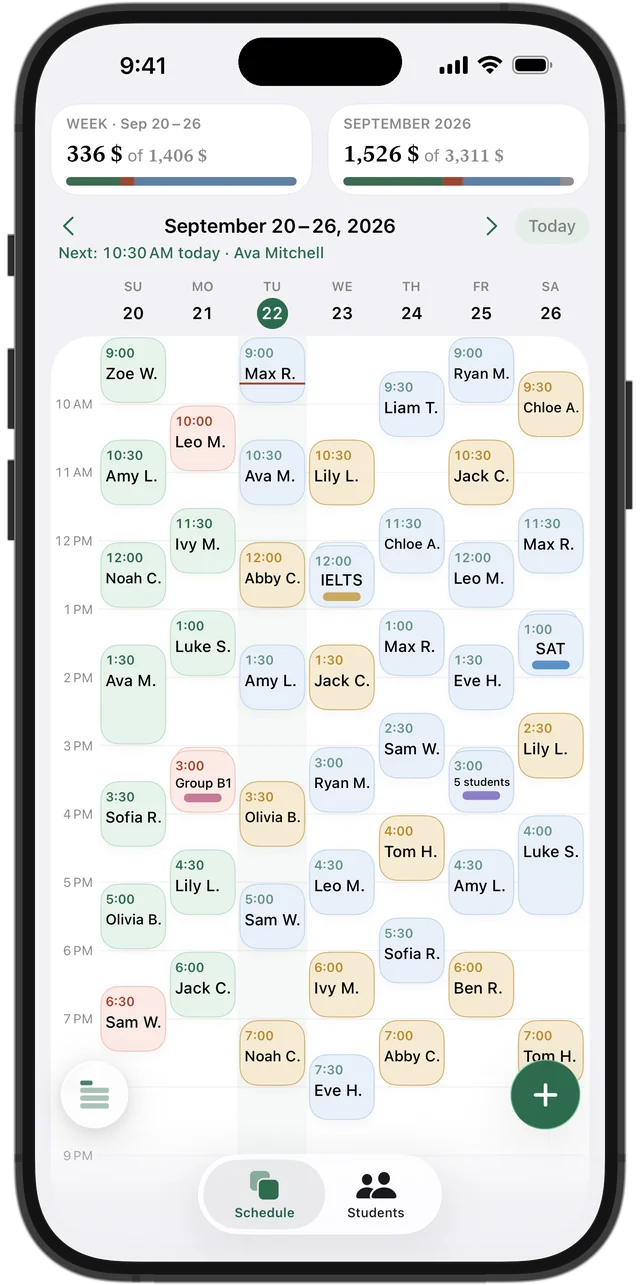
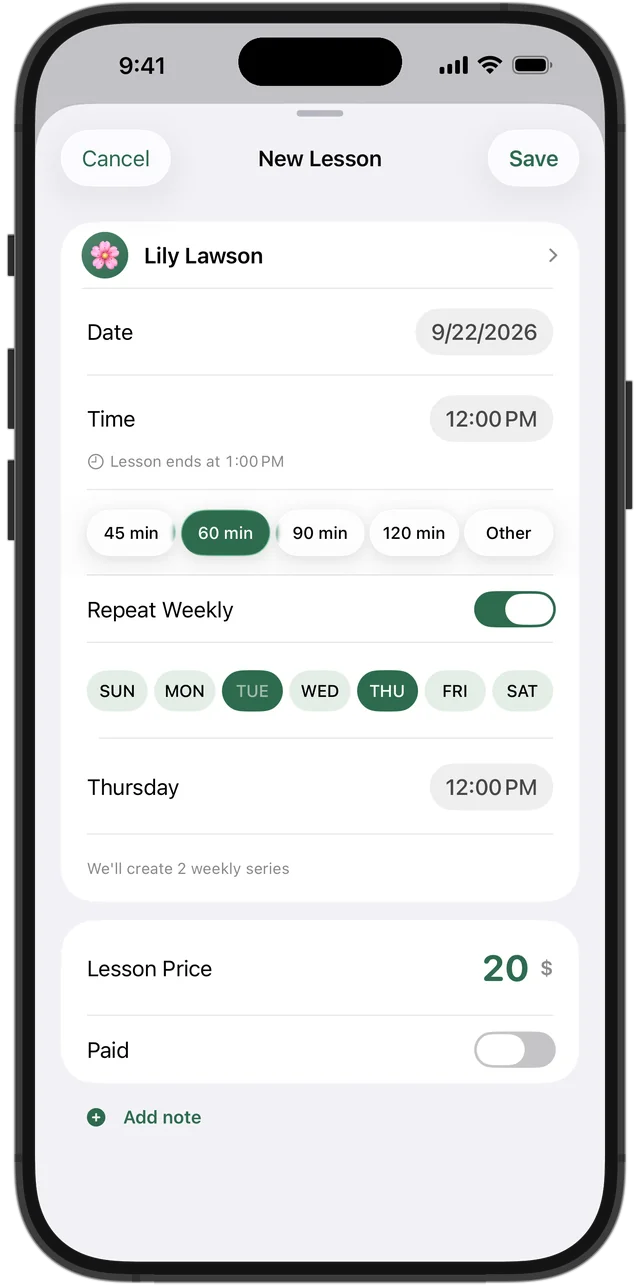
In Squool you create a weekly lesson once and it appears every week by itself. When a student pays, you add the amount to their balance and lessons are paid automatically, oldest first. The week grid shows payment state by color, so you see debts without opening anything.
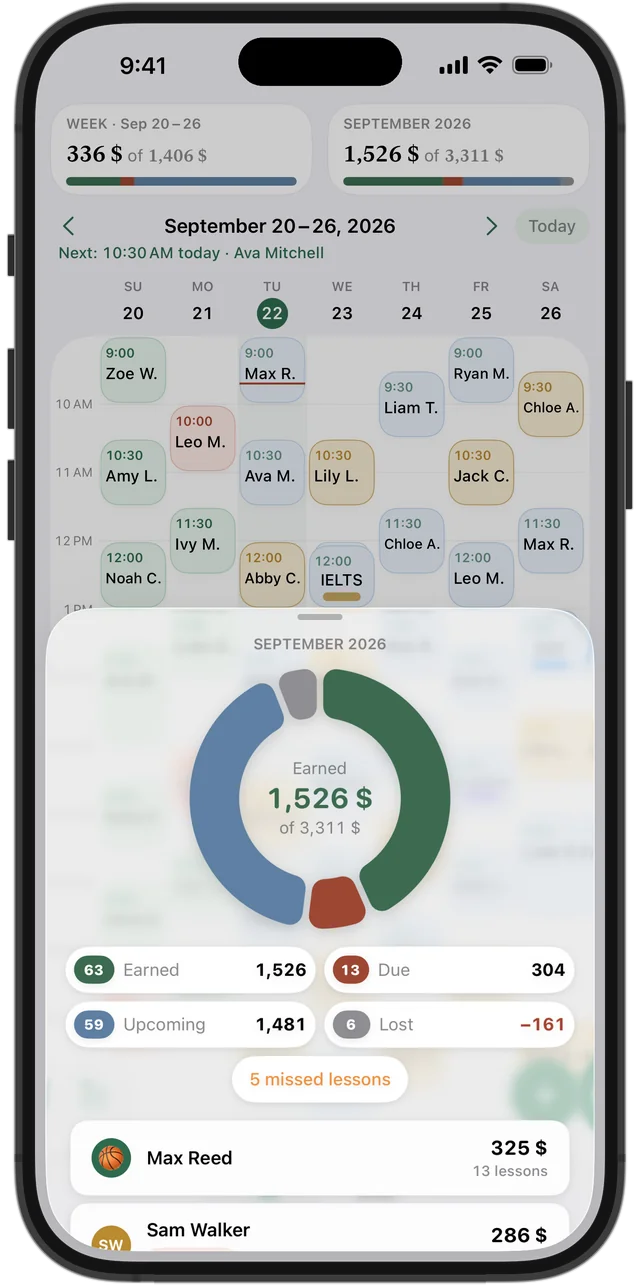
Earnings for the week and the month are counted for you: earned, due, upcoming and lost. You get a notification before every lesson, and the same schedule is on your iPhone, iPad and Mac.
An honest list of what an app does not do
Squool is for one teacher working alone. It does not send invoices, take payments online, let students book themselves or manage a school with several teachers. If you need custom accounting reports, keep a spreadsheet for that part.
You also cannot import a spreadsheet into Squool. You add students by name and price, enter their current balance as a payment, and turn on weekly repeats. If your lessons are already in Google Calendar or Apple Calendar, Squool can bring students and recurring lessons over from there.
Try it side by side
The fairest test is to run both for two weeks. Squool gives 14 days of full access free, no card required, on iPhone, iPad and Mac. Your data stays on your device and in your own iCloud — the developer can't see it — and you can back everything up to a file at any time.
Questions and answers
Is there a Google Sheets template for tutoring?
You can build one in minutes: a Lessons tab (date, student, price, status), a Payments tab (date, student, amount) and a SUMIF balance per student. That is enough for a few students who pay per lesson.
Excel or an app — what is better for a private tutor?
A spreadsheet is fine for a few students and custom reports. An app saves time once you have weekly lessons, prepaid packages and want to check the schedule on your phone.
Can I import my spreadsheet into Squool?
No. You add students by hand and enter each current balance as a payment. Students and recurring lessons can be imported from Google Calendar or Apple Calendar.
Is a paper notebook enough for tutoring?
Yes, for a small number of students who pay after each lesson. It gets hard with prepayments, rescheduling and monthly totals.
Does Squool work offline?
Yes. Data is stored on the device and syncs through your iCloud when you are back online.
Read also
Tracking payments
A simple way to track tutoring payments: one balance per student, prepaid lessons, who owes you and how much. Works on paper, in a sheet or in an app.
Recurring lessons
How to plan a weekly tutoring schedule: students twice a week at different times, moving one lesson, changing time or price for future lessons, ending a series.
Calendar import & sync
How tutors can move students and weekly lessons from Google Calendar or Apple Calendar into a lesson app, and sync the schedule back with color-coded payments.
Tutor income
How a private tutor can see real monthly income: what is earned, what is still due, what is planned and what cancellations cost. A simple method and an app.
Try it free for 14 days
No card required. Subscribe only once the app has proven it's worth it to you.
Download on the App Store